Newton's first law of motion is often stated as
There are two parts to this statement :-An object at rest stays at rest and an object in motion stays in motion with the same speed and in the same direction unless acted upon by an unbalanced force.
- Predicts the behavior of stationary objects.
- Predicts the behavior of moving objects.


Everyday Applications of Newton's First Law
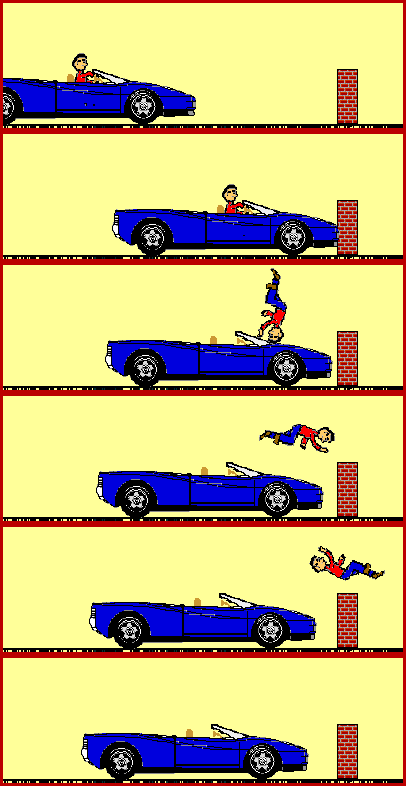
There are many applications of Newton's first law of motion. Have you ever experienced inertia (resisting changes in your state of motion) in an automobile while it is braking to a stop?
The force of the road on the locked wheels provides the unbalanced force to change the car's state of motion, yet there is no unbalanced force to change your own state of motion. Thus, you continue in motion, sliding along the seat in forward motion. A person in motion stays in motion with the same speed and in the same direction ... unless acted upon by the unbalanced force of a seat belt.
The seat belt provides the unbalanced force that brings you from a state of motion to a state of rest. Perhaps you could speculate what would occur when no seat belt is used :-
There are many more applications of Newton's first law of motion. Several applications are listed below:
- A brick is painlessly broken over the hand of a physics teacher by slamming it with a hammer.
- To dislodge ketchup from the bottom of a ketchup bottle, it is often turned upside down and thrusted downward at high speeds and then abruptly halted.
- While riding a skateboard (or wagon or bicycle), you fly forward off the board when hitting a curb or rock or other object that abruptly halts the motion of the skateboard.
